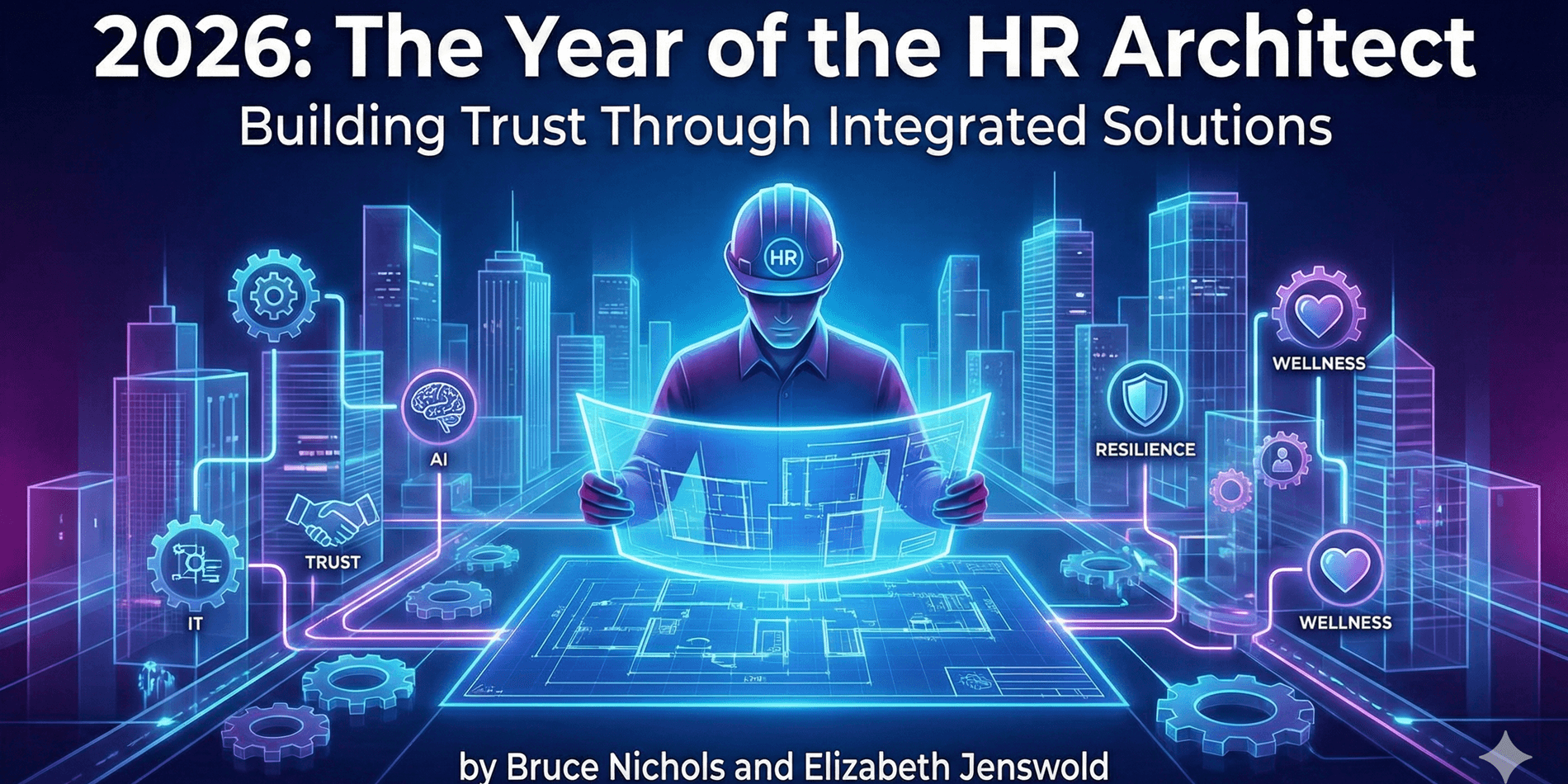
by Bruce Nichols and Elizabeth Jenswold
The finish line of 2025 is behind us. For many of us in the HR executive space, the last twelve months were a whirlwind of technology pivots, shifting workforce models, and the constant pressure to deliver more with less. But as the calendar turns, a new mandate is emerging.
In 2026, “Human Resources” is no longer just a department or function; it is the ‘mastermind of strategic glue’ within resilient organizations.
The Power of Integrated Solutions
For years, HR has operated in silos, e.g. talent acquisition, compensation, benefits, and learning often living in different worlds. In 2026, success belongs to those who deploy integrated solutions. This means:
- Alignment and Integration of HR Strategy, Mindsets, Policies, Practices: With organizational strategy and desired culture as cornerstones, make it easier and common-sensical for leaders to lead and employees to perform successfully and reap rewards while elevating customer experience/loyalty and profitability. Ensure active inter-connectivity in the work of HR.
- Blending AI with Human Strengths: Not just using a chatbot, but redesigning workflows so AI handles the routine while your people focus on creative, relationship-driven work. Utilizing AI and automation to remove the “grind” will give people ‘mental white space’ to innovate. Technology Serves the Human is key to a “People First” strategy.
- HR and IT Convergence: Partnering deeply with technology teams to ensure that the “digital employee and customer experience” is as seamless and supportive as the physical one… ensuring the organization’s values and desired persona are consistently modeled and felt by all stakeholders.
- Unifying Talent Intelligence: Anchored by adept predictive analytics, connecting skill gaps directly to talent selection and onboarding, employee and leadership development, and succession planning.
- Talent Intelligence Meets Organizational Health: Burnt-out workforces cannot execute a high-growth roadmap. Strategic talent development must include capacity management in addition to building trust and resilience.
Building Trust in an Age of Automation
As we integrate more technology, it’s critical to remember that trust is our most valuable currency. 2026 will test this. With 82% of boards of directors looking to AI to reshape workforces, employees are looking for clarity.
- Transparency Over Complexity: Be honest about how AI affects roles. Trust isn’t built by avoiding the conversation; it’s built by leading it. Ensure employees know where staffing needs will be, providing ramps to gain new skills and abilities to advance their career journey.
- Psychological Safety as Strategy: High-trust workplaces are safer for innovation. When people feel secure, they don’t fear the machine—they learn to drive it. High trust workplaces (e.g. Great Place to Work Institute) include some of their metrics.
- Leading by Example: Trust is built when employees see their leaders prioritizing physical and mental wellness while modeling the organization’s values.
- The “Work-Rest” Contract: Be deliberate about when the team is “on” and when they are “off.” Clarity in expectations reduces the silent anxiety that erodes trust.
The Foundation: Reflection and Resilience
In 2026, resilience becomes a leadership competency: the ability to think clearly, manage energy, and recover intentionally in an always-on environment.
We are challenging ourselves, our teams, and our partners to design capacity creation into the workday, not as an afterthought:
- Energy Renewal: High-performing leaders restore energy in different ways; through movement, stillness, reflection, or focused solitude. What matters is creating intentional space to reset cognitive and emotional capacity.
- Deliberate Transitions: Leaders who effectively manage transitions between intensity and recovery make better decisions and reduce organizational drag.
- Protected Focus: Deep, uninterrupted thinking time is not a luxury — it is a strategic mandate.
- Sustainable Rhythms: Resilient teams operate with clarity, flexibility, and recovery built into how work actually gets done.
At The Human Resource Consortium, our work in 2026 will be focused on helping organizations design human capacity to sharpen execution. We design and build roadmaps to create competitive edge for and more importantly, we strengthen people to successfully complete their journey and win.