

The Current Landscape and Conundrum
For thirty (30) years, we’ve transformed many clients’ ‘Missions Impossible’ to significant wins in Fortune 500s and privately or PE owned, mid-sized organizations.
We’ve also carefully monitored global and U.S. employee engagement metrics including this past decade’s plummet to record lows.
- In 1Q 2025, Gallup reported their 2024 results. U.S. businesses lost $500B annually due to an average of 69% employee disengagement and 66% manager disengagement. Their global data is 10% worse.
- Salaries and benefits costs dominate the top expense line items on organizations’ profit and loss (P&L) statements. How can an organization survive, much less, thrive on 31% engagement?
Our team recently agreed this challenge is another ‘Mission Impossible’ for us to tackle. In assessment of the deplorable engagement levels, a few weeks ago I was sharing my belief that leadership development needs to be reinvented with someone who replied, “the market is saturated with leadership development consulting firms.” My reply was “Well then, clearly they’re not working. We need a different solution.” Our team of strategic and operational HR & OD experts, most with F100 pedigrees, agrees wholeheartedly.
This performance challenge must be taken to heart with relentless verve to find truth and an innovative solution NOW… not later. Employees’ view? Many organizations are adding jet fuel to disengagement fires by leaping into full-fledged AI implementation to increase productivity speed at less cost, while elevating change-fatigue, distrust, engagement declines, turnover, and RIFs.
Engagement or Trust?
Nine of our firm’s thought leaders conferred in an initial, deep dive debate… is ‘engagement’ or ‘trust’ the more critical measure to assess and develop an organization’s potential for higher performance. Considerations were significant for both. This team comprised HR and OD experts from global and domestic organizations across industry sectors, most with business operations expertise and many large-scale transformational challenges they’d aced:
- Yvonne Alverio – Inclusion & Collaboration Practice Leader and Executive Coach
- Gregg Barratt – HR & OD Practice Leader
- Elizabeth Jenswold – Sr. HR & OD Consultant
- Larry Kuhn, PsyD – Organizational & Clinical Psychologist and Executive Coach
- Kawel LauBach, MSOD – HR & OD Practice Leader and Executive Coach
- Nancy Martone, MS – Healthcare Practice Leader and Executive Coach
- Bruce Nichols – Principal and HR Practice Leader
- Gavin Pommernelle, MBA – Organization Design & Development Practice Leader and Executive Coach
- Regan MacBain Traub, CPC – Founder & Managing Principal.
In addition to Gallup’s metrics and methodology referenced above, we examined the work and findings of the Great Place to Work Institute (“GPTWI” best known for Fortune Magazine’s 100 Best Companies List). Differently from Gallup’s focus on the index of ‘engagement,’ GTPWI focuses on the index of “trust.” Their ‘100 Best’ Companies’ engagement scores range from the mid-80s to mid to high 90s. Additional powerful and compelling data for the ‘100 Best’ includes their outperformance of 100 – 9,000 employee, non-GPTWI organizations in a 27-year cumulative stock market average return by 3.5X, score 1.42X higher innovation, 1.38X higher productivity, and 1.21-1.25X higher agility.
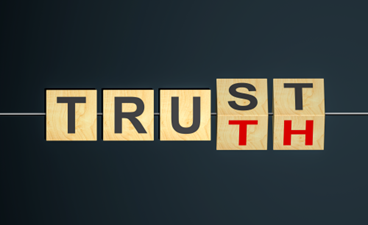
Dr. Kuhn’s psychological expertise weighed in on the relevant ‘chicken or egg’ or which comes first question, in this case – engagement or trust. “The answer is Trust… people in an organization need to feel a sense of trust before they experience engagement.”
To What Degree Does Trust Matter?
Answering the first question led to the second… to what degree does trust matter to an organization’s wellbeing? If you, as a leader are trusted by employees as well as customers and investors, what impact might you have on your organization’s success? Here’s what GPTWI’s research on trust as the #1 driver of performance reveals about their ‘100 Best Companies:’
- 15X more likely chosen as employer of choice by candidates
- 8.5X more revenue per employee than U.S. average
- 4X greater employee retention
- 3.5X outperformance of 27 yr cumulative stock market average returns
- 1.42X higher innovation than non-GPTWI companies with 100 – 9,000 employees
- 1.38X higher productivity than non-GPTWI companies with 100 – 9,999 employees
- 1.21-1.25X higher agility than non-GPTWI companies with 100 – 9,000 employees
Got your attention?
Sparking Trust
This third question emerged from the answer to the second…what sparks a sense of trust in people/employees? We readily agreed that perceived trust of an individual is a result of the individual being seen as a transparent and truthful person. So, what contributes to an individual’s being seen by others as speaking or acting in a way to be recognized as:
Transparent?
- Eyes remain connected with their audience (individual, team, or large audience).
- Voice is clear, calm, and regulated.
- Messages resonate with the audience’s experiences and insights.
- Choices of words are those the audience will easily grasp.
- Physical stance is steady, relaxed, and open (arms are not crossed or akimbo indicating defensiveness, anger or ego / power)
Truthful?
- Choices of words are ‘normal’ for that individual.
- Presence is seen as attentive, humble and genuine.
- Communication style is thoughtful, conversational and caring.
- Key messages include the why(s), what(s), how, organizational impact, planned action(s), who is involved and why, anticipated outcomes/what success will look like, anticipated difficulties, what is needed from employees to attain optimal outcomes through the challenge, and the cadence and mode of updates.
- Transitions in content are punctuated by pauses with opportunities for audience questions.
Acceleration of Trust Building?
The answers to this fourth question about how we can accelerate the development of trust may be a bit more ‘sticky.’
- Historic patterns of transparency and trusted communications is common sense.
- Shared passion for mission and personal values are definite contributors to more quickly infuse trust.
- Relationship development is a two-way dependency that enables the creation and increase of trust, fueling abilities to perform, collaborate, innovate and actualize more successfully while stimulating greater enjoyment of work.
- Alignment and integration of goals can ignite collaboration by building affinity between people seeing how their roles and goals interplay, more easily ‘winning together.’
- Perspectives tend to differ based on our unique experiences. Yet, it is our differences in perspectives which create greater potential for innovation. Learning to balance among differences from our experiences is an interesting dynamic to master. Education in how to respectfully work through differences to elevate inclusion, collaboration, and innovation becomes vital.
- Aligning organizational operations with leadership and behavioral dynamics is a bit more challenging. Our clear delineation of concepts are:
- Leadership (not “management”) pertains to people at all levels of organizations. The ability to manifest trust, integrity, emotional and social intelligence, a sense of caring, humility, and adept strategic or operational decision-making are some of the qualities of exemplary leaders;
- Management, on the other hand, pertains to function operations, reporting, budgeting, processes, practices, and technology. Due to lack of clarity here, might concepts of ‘management’ of people contributed to power-based dynamics which now contribute to deteriorating trust in organizational cultures?
- People with different roles, prior experiences, as well as both tenure and nature of experience with your organization may require different amounts and levels of insight to successfully perform their job and ultimately progress along their desired career path. An ‘aha’ comes to mind for me.
Over the years, I have found Employee Stock Ownership Program (“ESOP”) leaders’ commitment to educate all employees (who have just become co-owners) about how the organization works, how to read and grasp financial statements, how decisions will be made, how each person and their role contributes to the performance outcomes of the organization to be both remarkable and laudable… building a greater sense of accountability, pride, and transparency among their workforce. Perhaps there’s some timely wisdom here.
Is AI Gaining Trust? Is It Trustworthy?
Did you know that inquiries through Chat GPT and AI LLMs have already eclipsed those of Google? To what degree and why have people already become that much less patient for information and/or outcomes? To what degree are people fully trusting the data held and conveyed by the LLMs? A couple important questions arise with respect to the degree AI data is trustworthy related to:
- Employees’ organizational decision-making by AI query rather than consulting with relevant organizational leaders or managers who may not be readily available for a meeting, phone call, email or text?
- Physical and mental health issues rather than waiting for an appointment with expert physicians or psychologists?
- The safety of organizational or personal information and its potential leakage, misuse, and/or deep fake use?
Are we ready and secure enough for this new technological era to protect the confidential information, wellbeing, and reputation of organizations and people? If not, what will that require? Trusted expertise in IT and Cybersecurity will be crucial.
In Conclusion
The next several years will be filled with critical decision-making. Navigating the futures of organizations was already complex… add the escalation of AI, divergent geo-politics, and economic uncertainties. We each have an opportunity and a duty to learn, grow, and choose wisely for people to foment a relationship-based, thoughtful, productive, successful, healthy, peaceful, and vibrant future ahead.
There is no doubt in our minds at The Human Resource Consortium…
“Creating Organizational Performance, Trust, and Value compels us to build ‘People-First’ Cultures powered by Integrated HR Frameworks — aligning leadership, strategy, relationships, and innovation enabled by technology — not defined by it. Technology supports performance — but doesn’t inspire it. People do.”
Elizabeth Jenswold and Regan MacBain Traub


