


by Bruce R. Nichols, Principal & HR Practice Leader
Executive Summary
Conversations regarding AI integration and supporting change strategies have established two truths: AI readiness is a strategic, holistic endeavor, and success hinges on radical communication and psychological safety. However, in practice, many organizations still communicate AI integration as a technology, process efficiency, and/or change management initiative rollout fueling employee anxiety about job displacement.
In this article we begin to explore shifting the focus from managing fear to architecting the future. AI’s successful integration will rely on the ability of Human Resources to elevate communication from a change management tactic to the People-First strategy itself. We argue that transparent, frequent, and empathy-driven communication is the essential framework for success. It must be directly integrated into three critical strategic pillars:
- Organizational Strategy (the ‘Why’);
- Talent Planning (the ‘Who’); and
- Skills of the Future (the ‘How’).
By intentionally integrating communication with process, focused development, and career pathing into these core functions, leaders can transform employee resistance into engagement, ensuring that AI serves as a powerful tool for augmentation, not just automation.
The Strategic Imperative of Trust
Concerns surrounding implementation of Artificial Intelligence often overshadow and displace the foundational work required to make it successful. Organizational readiness requires a strong technological base, a culture of psychological safety, and a personal sense of curiosity and desire to grow to ensure employees feel seen, heard, and supported through change. Yet, even in organizations that champion transparency, the conversation about AI frequently remains transactional, focusing narrowly on implementation deadlines and efficiency metrics. This approach treats communication as a tactical announcement rather than a strategic asset. Having a front seat to massive organizational change and bearing witness to the crucial communication planning for 20 years in three Fortune 500 organizations, I can attest to the uncertainty that immediately calls trust into question as soon as the first whisper of AI is heard.
Leaders failing to connect AI implementation to a vision for the business and the growth of their teams will likely spur employees to fear change and question their longevity. The principal narrative becomes one of their job’s displacement rather than potential role augmentation and professional growth. This is a pivotal moment for Human Resources leadership.
The next phase of AI integration requires moving beyond simply telling employees about change; it requires HR to architect a People-First Strategy where transparency is fully woven into the fabric of the organization and becomes a framework for how leaders can intertwine continuous, empathetic dialogue and story-telling success into Organizational Strategy.
Embedding Communication in Organizational Strategy… The Why
The story of “why” is the most potent tool a leader has. In working with a CIO within a large global organization her first question to all initiatives was “why is this important?” or “what is the why”. These direct and intentional questions to change created purpose, minimized resistance, and provided guidelines for subsequent decisions once the question was satisfied. To create success with AI, change communication must be integrated into corporate vision, making the AI mandate feel like a growth opportunity, not a forced cost-cutting measure.
Clarity Over Cliches: Linking AI to Business Outcomes
Generic phrases like “We are adopting AI to increase efficiency” are too easily dismissed as corporate jargon by failing to instill the growth mindset necessary for success. Instead, the “why” must be a compelling link between the AI initiative and the organization’s strategic goals and ability to further its competitive edge.
- Instead of saying, “AI will handle customer support,” communicate that, “AI will automate 80% of routine transactions and support inquiries, freeing our skilled agents to handle complex problem-solving which directly supports our 3-year goal of achieving a world-class customer experience (CX) rating.”
- Always start with the business problem AI is solving. Are you battling high attrition due to burnout? Is manual data processing slowing innovation? When employees understand the depth of the challenge, they are more likely to view the AI tool as a partner, not a threat.
Working through an organizational “Transformational Journey” (streamlining process, updating platforms and data storage, and implementing AI), our team realized gains in employee engagement. Impacted areas with our change strategy returned positive eNPS scoring and commentary when we clearly communicated our “why.” Individuals wanting to advance their technology skills by moving from outdated technology stacks and aging skillsets found “opportunities to grow with the team.” And, individuals with interest in retaining responsibilities with outdated technology were provided an alternate career move to an organization with which we had partnered for this purpose.
AI Mandate as a Value Statement
Ethical boundaries and governance while ensuring your AI strategy embraces corporate values becomes an integral key to success, Communication is a tool that translates these guide lines into a commitment to your team. Employees need to see that the AI strategy adheres to, and is aligned with the same vision and values that define the company culture.
Transparency means explaining when and how humans will retain authority and gain ‘agency.’ Ensuring we demonstrate that we value integrity, your communication must clearly state where human interaction will supersede AI’s integration into a process. For example: an AI policy regarding hiring could state the following, “Our AI policy requires a human-in-the-loop for all selection and final hiring decisions. This always ensures human judgment and fairness review of algorithmic recommendations. This reinforcement and commitment to a People-First policy will enhance stated corporate values making the AI change strategy palatable to your team.”
The Leadership Litmus Test
Executive teams cannot delegate the communication of the “why” solely to HR or Change Management. Top-down, consistent messaging is required to signal strategic importance. Embracing an integrated change strategy with key change champions throughout the organization will assist the litmus test to return to aligned, ‘One Voice’ favorable results.
- With regular “State of the AI” dialogue, leaders demonstrate a commitment to authenticity. Ongoing open formats like town halls show them to be willing to sit in the unknown questioning that require improvisation. In these sessions they must communicate what they know, what they don’t know, and the process for finding out. Rigorous follow up and commitment to this strategy will signal to the workforce that the journey is a shared, continuous process, not a final, fixed destination. When leaders admit uncertainty and show confidence in the process, they build trust.
- Change champions entrusted to deliver key messages from leaders to their workplace communities can be strategic agents needed for the AI integration journey. They can demonstrate the understanding of the change from the team to leadership. The journey ahead may be uncertain, yet trusted, key voices throughout strengthen confidence in the process.
A leading financial services organization tasked its Human Resources (HR) executives with creating a new operating model. The objective was to build a modern service delivery model that would: integrate new technologies, eliminate redundant processes, mitigate risk, and ensure alignment with the broader organizational strategy.
The potential impact on the HR function was immense, with the anticipation of significant efficiencies that could lead to the elimination or redefinition of several roles. To manage this scale of change and ensure successful adoption across the entire organization, the alignment of the change management and communication strategy was paramount.
This strategic change required a comprehensive communications effort, which included:
- Stakeholder Management: Continuous engagement and alignment with C-suite executives and key sponsors within the HR leadership team.
- Technology Demonstrations & Training: Providing clear, accessible demonstrations of the new technologies to show employees how they would work as well as the achievements and value they would create.
- Process Co-Creation: Building new processes collaboratively with the teammates directly involved or impacted by the change, ensuring their input was integrated from the start.
- Strategic Branding: Developing a dedicated brand and narrative to support the change initiative and communication strategy, giving the transformation an identity.
- Extensive Change Champion Network: Establishing a robust network of internal advocates to drive excitement, manage local concerns, and facilitate two-way communication throughout the organization.
The success of this transition hinged on treating communication not as an afterthought, but as an integral part of the technology strategy, addressing both the ‘what’ (the technology) and the ‘how’ (the human impact and new way of working) including their role as part of an energized, ‘new age’ team in our industry.
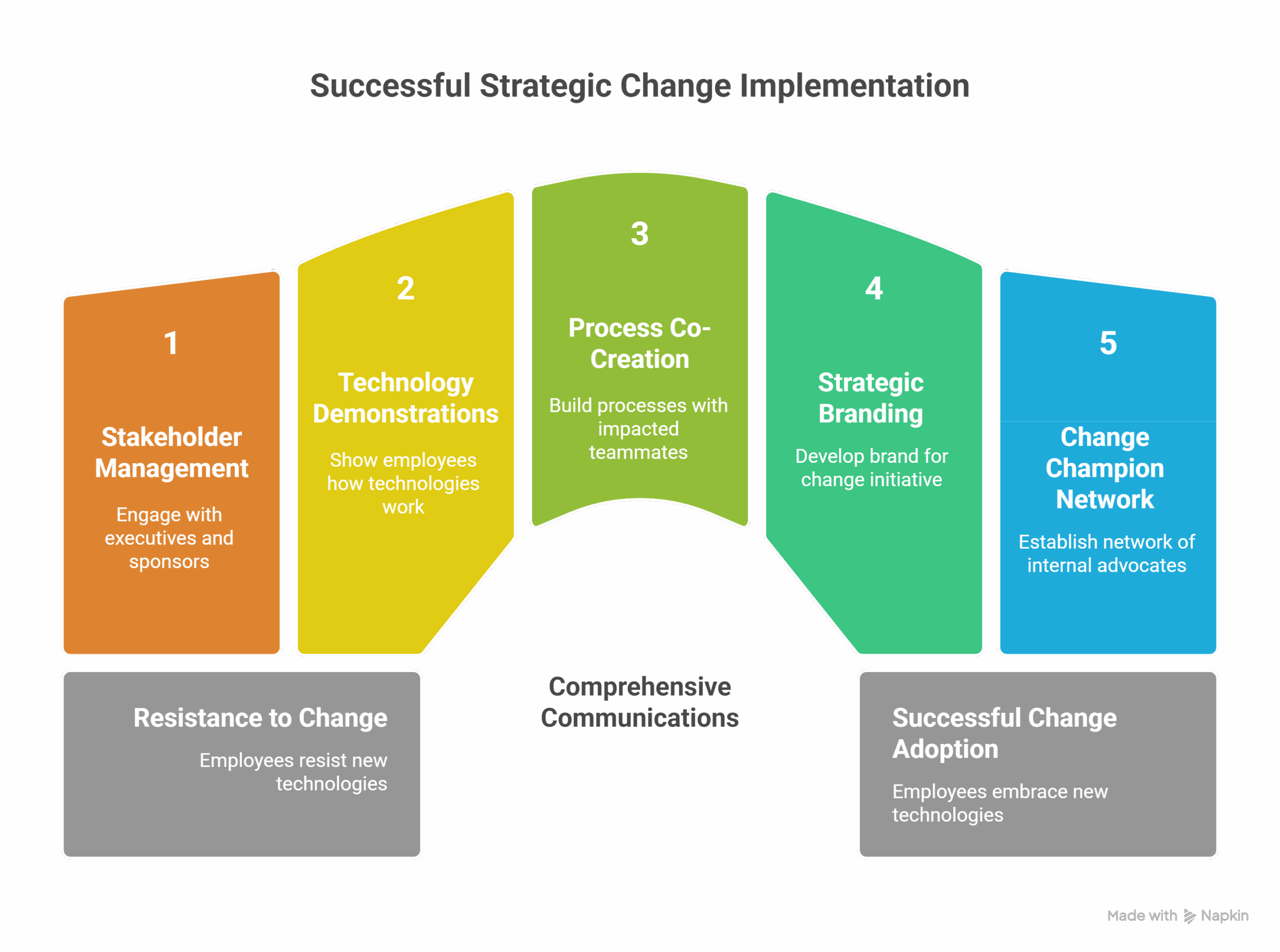
Successful Strategic Change Implementation
Integrating Communication in Talent Planning
Once the organization understands the strategic “why,” the natural next questions for every employee are personal. Who is affected? What will my future role look like? Will I experience greater job satisfaction? How will these skills support my career potential? In the absence of direct, detailed answers, fear and skepticism, HR needs to fill the void. Its role is to ensure communication is proactively embedded into the talent planning process to transform potential job loss anxiety into career mobility excitement.
Communicating the Shift to Role Augmentation
The most destructive narrative is that AI will destroy jobs and derail careers. Intentionally replacing “job displacement” with “role augmentation” becomes a critical part of the transformational journey. When technology entered the office in the 1990s, the secretary’s job didn’t disappear; the tasks changed, and the role evolved into the Administrative Assistant and then Virtual Assistant. Communication should focus on this evolution.
- Leaders and managers, in partnership with human resources, need to clearly define and communicate which specific tasks AI will assume, and which higher-value tasks the employee will now own. This evolves the conversation from “you are being replaced” to an aspirational statement of “we are taking away the tedious 30% of your work so you can focus on the critical 70% that drives our core business and will support your career goals.”
Mapping Internal Mobility and Career Paths
The communication must not end with the description of new tasks. It must be paired with a tangible, well-resourced career pathway with potential for greater personal, professional and organizational impact. This connects today’s change to tomorrow’s opportunity.
- Human Resources should now work to communicate career maps showing the logical progression from an augmented role. For example, an Analyst running reports and building queries are now augmented with AI to enable a growth of their skills into the data analysts and potentially data science careers.
- This is the ultimate proof of the People-First Strategy. Every communication about AI must simultaneously announce the resources—time, budget, and learning platforms—dedicated to ensuring employees can bridge their current skills to the future needs of the augmented roles. This transitions the employee from viewing AI as a competitor to seeing it as a career accelerator.
During a recent organizational shift, a senior technology executive was tasked with building a centralized Data Engineering team. This initiative required combining several teams from across a larger technology organization. It was driven by a clear strategic imperative — to reduce reliance on an aging platform and successfully transition the entire data science community onto a new, shared, and modern platform.
Through this process, leaders conducted a deep dive into the specific skills required for success in the newly centralized team. Recognizing the skills gap, the focus shifted to developing capabilities within the current team members rather than solely recruiting externally.
Discussions around machine learning, AI augmentation, and future-proofing skills quickly highlighted the critical need for a robust and transparent communications process throughout the transition.
Key to the success was the commitment that job loss, disguised as efficiency gains, would not be realized, even though roles and responsibilities were changing and uncertainty was prevalent. This was achieved by:
- Clear Mapping of New Skills: Explicitly identifying and communicating the new skill sets required for each restructured role.
- Integrated Development: Clearly communicating the plan for team development and upskilling, integrating training, mentorship, and project work directly into the transition timeline.
By focusing the communications strategy on growth, skill development, and stability rather than only technical change, the executive successfully navigated the consolidation while ensuring team morale and organizational trust remained high.
Embedding Communication in Future Skills (The “How”)
The final consideration for the People-First Strategy is defining the “how.” This moves the narrative from fear of the unknown to the concrete, actionable plan for growth, directly appealing to the need for a growth mindset. Communication is less about announcing and more about empowering and enabling.
The Two-Track Skills Communication
HR must clearly differentiate between the two types of skills required for the AI future and communicate the learning plan for each:
- AI-Specific Competencies (Tool Proficiency): These are the technical and operational skills needed to interact directly with the new AI systems (e.g., prompt engineering, data validation, output interpretation). Communication here should focus on targeted, role-specific training modules, mentorship, and access to internal AI sandboxes for safe experimentation.
- Human-Centric Competencies (Future-Proof Skills): These are the uniquely human skills that AI will unlikely be able to replicate, and they are critical for the augmented roles. These include emotional intelligence, critical thinking, complex communication, and ethical reasoning. Communication must stress that these are the most valuable skills of the future and commit to investing in soft-skill development programs.
Leveraging Social Influence with AI Champions
One of the most effective ways to break down resistance is to use social influence. Letting employees hear about the change journey from their colleagues, not just from leadership.
- The Champion Network: HR wins when it’s successful in identifying and empowering a network of AI Champions—early adopters, natural communicators, and trusted peers from different departments. Their role is to co-communicate the change, share success stories (both technical wins and lessons learned from failures), and provide immediate, low-barrier support to colleagues.
- Failure as a Feature, Not a Bug: Champions should communicate that AI integration is an iterative process, embracing the improv principle of “Embrace and learn from failure.” This is communicated through internal blogs or Q&A sessions where Champions openly discuss their early mistakes and how they pivoted. This normalization of error builds psychological safety and encourages experimentation across the organization.
The Continuous Feedback Loop
For the People-First Strategy to work, communication must be bidirectional. Employees need to see their concerns and insights actively shaping the training and deployment process.
- Post-Implementation Pulse Checks: After initial AI rollout and training, to ensure greater success and engagement, HR will benefit from utilizing frequent, anonymous pulse checks and small-group listening sessions to gather real-time feedback.
- “You Said, We Did” Communication: A commitment to transparency means publicly communicating the outcomes of this feedback. For instance, “You said the initial prompt engineering course was too theoretical. We heard you, and based on your feedback, we added three new hands-on workshops with live data to address this.” This demonstrates that communication is an active, ongoing partnership that directly impacts their work experience.
Conclusion: The New Mandate for HR
AI is not merely a technological upgrade; it is a fundamental transformation of the human-work relationship. The success of this evolution rests squarely on HR’s ability to treat communication not as a change management checklist, but as the central, animating force of a People-First Strategy.
By embedding transparent, continuous dialogue into Organizational Strategy (the Why), Talent Planning (the Who), and Skills of the Future (the How)—organizations can proactively dismantle fear and build trust. This strategic approach transforms employee uncertainty into engagement, making AI integration a journey of collective growth and skill augmentation.
The ultimate measure of AI success won’t be in efficiency gains alone, but in the retention of highly skilled, future-ready employees who feel their organization invested in them – and with them. The new mandate for HR is clear: Communicate, communicate, communicate. Be transparent about the strategy, be honest about role changes, and be relentless in enabling new skills. By doing so, leaders ensure their organization becomes a lifeline to the future, not just a passive observer of the past.


